JPMorganChase Headquarters, New York, United States
November 2025
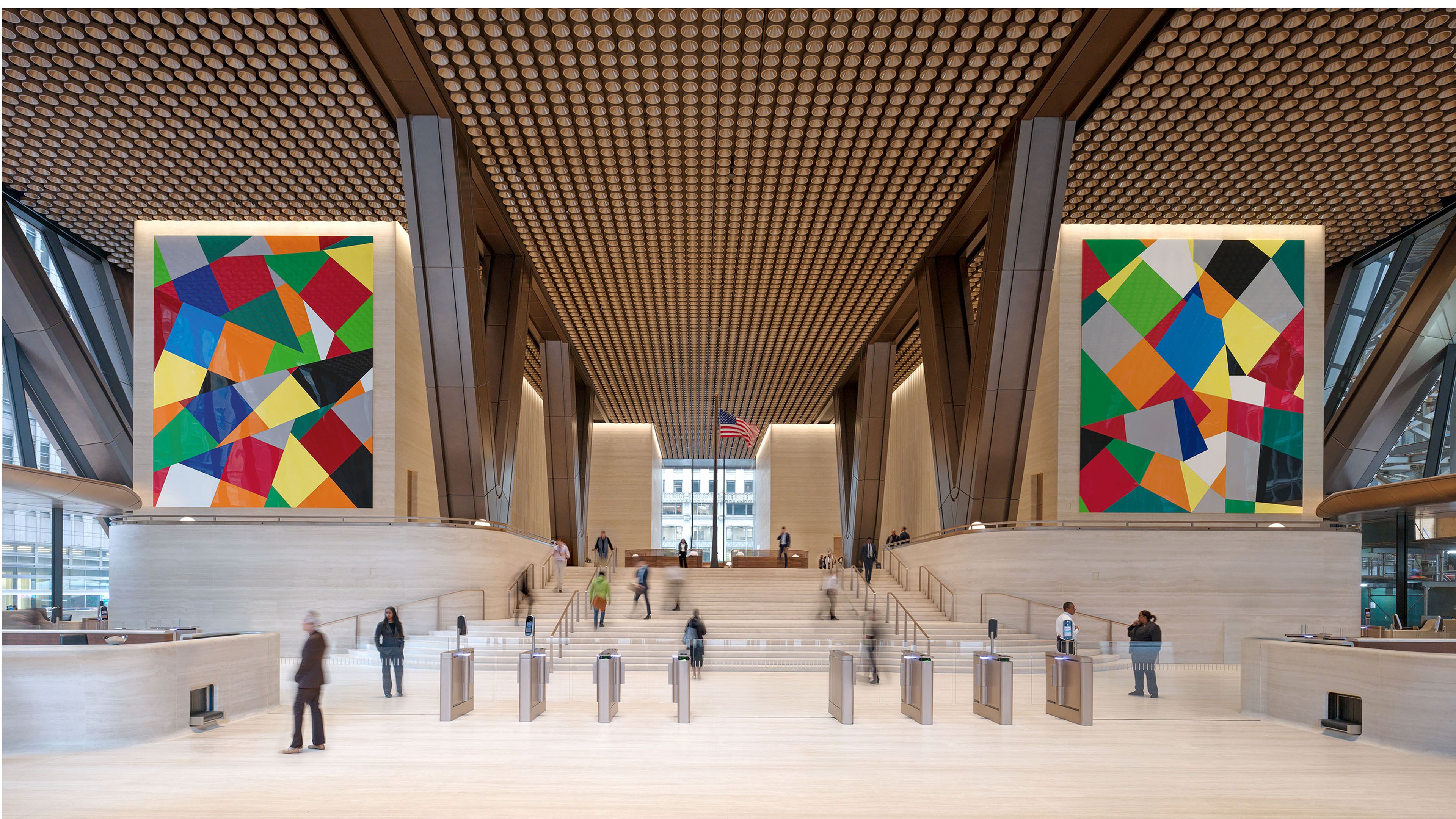
David Zwirner is pleased to share the news of a major new installation by Gerhard Richter (b. 1932), as reported earlier in Artnet News. Situated in the foyer of 270 Park Avenue, the newly opened global headquarters of JPMorganChase (who commissioned the work), Richter’s 2024 installation comprises two painted aluminum works, Color Chase One and Color Chase Two, and unites multiple important threads from the artist’s practice.
Each measuring 10 by 8.4 meters, they are made with interlocking, hard-angled aluminum shapes that are painted in twelve distinct high-gloss colors and combined to fit precisely together in arrangements that together form the rectangular, monumentally scaled panels. The installation references compositional forms that originated in Richter’s 2023 series of collages—a new medium for the artist. In turn, those collage works formally and conceptually recall Richter’s groundbreaking series of Farbtafel (Color Chart) paintings from the 1960s and 2000s, which took the form of multiple colored squares arranged in a randomly organized grid. Initially inspired by the standardized rectangular format of commercial paint samples, the Color Charts spoke to Richter’s longstanding interest in incorporating chance occurrences into the image-making process. This commission also continues Richter’s rich history of creating installations that reflect their surroundings, a practice he first began more than half a century ago with his landmark 1967 installation 4 Panes of Glass. Richter has consistently maintained an analytical and wide-ranging fascination with mirrored and reflective surfaces, positioning these as a literal reflection on the traditional act of painting. Since the 1960s, the scope of the artist’s reflective installations has grown to include industrial-scale mirrored panes, intricate stained-glass windows in vibrant color, and colorful and glossy enamel-painted aluminum panels—as in the Color Chase works—among other formats. In addition to painting, Richter has also worked prolifically in a variety of media since the beginning of his career, including sculpture, collage, and large-scale installations, and he has received important commissions from prestigious institutions and venues worldwide. In 1999, he created a towering paneled work, Black, Red, Gold, for the reception hall of the Reichstag Building in Berlin—the seat of the German government—on the occasion of the building’s renovation by Norman Foster; the work comprises three reflective glass panels, each respectively painted on their interior surface with one of the three colors of the German flag. In 2008, a major stained-glass window commission by Richter, made up of more than eleven thousand colored squares, was unveiled at the Cologne Cathedral. Other significant installations by Richter are housed in a dedicated pavilion on Toyoshima Island, Japan (2013–2015), and in the Dominican Church of Münster, Germany (2018), among other sites. In 2024, a memorial exhibition pavilion designed by Richter was unveiled at the International Youth Meeting Center near the Auschwitz-Birkenau State Museum in Oświęcim, Poland. Within the pavilion, a photographic version of Richter’s acclaimed 2014 Birkenau painting series is installed facing a large-scale gray mirror work by the artist, offering a site for personal remembrance and reflection. The newest and one of the largest of Richter’s public commissions, the Color Chase panels introduce unprecedented aspects of material and color into the artist’s endlessly experimental practice and expand upon his investigations into the act of painting. This site-specific installation transforms Richter’s dynamic collages into dramatic and monumental artworks that engage with the built environment and reflect and further activate the space in which they reside. Gerhard Richter lives and works in Cologne. From October 17, 2025—March 2, 2026, the Fondation Louis Vuitton in Paris is presenting a major retrospective of the artist's practice over six decades. Concurrently, Richter is having a solo exhibition at David Zwirner in Paris, on view through December 20, 2025.