New York: 52 Walker Street
November 6–December 19, 2026
There comes a moment in everyone’s life when the world steps back. Voices fade, gestures lose their urgency, and what once seemed stable begins to drift, as if seen in a different light. The gaze turns elsewhere—toward something unseen—as if reality itself was slipping through one’s fingers. Solitude is born in that subtle shift: it does not indicate the need to forsake the world, but to become aware of the space that separates every being from what it beholds.
To think is to linger in that distance. Each act of understanding creates separation: the mind lays out the world like a chessboard, searching for order, direction. But as the mind believes it has found the center, the surface bends—the chessboard reveals itself to be a sphere, and every movement leads not to an end, but to an endless return. Within its own limits, thought discovers the reach of its gaze.
Ancient myths described this threshold. Inanna descends into silence and loses her names; Orpheus sings into the dark that gives no reply; Gilgamesh seeks a boundary that will take him back to time; Narcissus dissolves into the reflection that snares him. For all of them, solitude echoes a voiceless question—the awareness that in every search one risks losing the way.
—Jem Perucchini, 2026
David Zwirner is pleased to announce an exhibition of new paintings and works on paper by Italian, Ethiopian-born painter Jem Perucchini at the gallery’s Tribeca location in New York. Following recent solo presentations at Fondazione Sandretto Re Rebaudengo, Turin, and Centro Andaluz de Arte Contemporáneo, Seville, this will be the artist’s first exhibition in the United States.
The exhibition takes its title from a painting on view, Sospiro (2026), which translates from Italian as “sigh.” A sigh—at once a breath, a pause, a release, a gesture—holds significance for Perucchini because of its qualities both essential and transient, audible and invisible. As the artist describes, this fleeting moment of vitality represents “the passage between the inner self and the external world, between soul and body, between what is held within and what is released.”
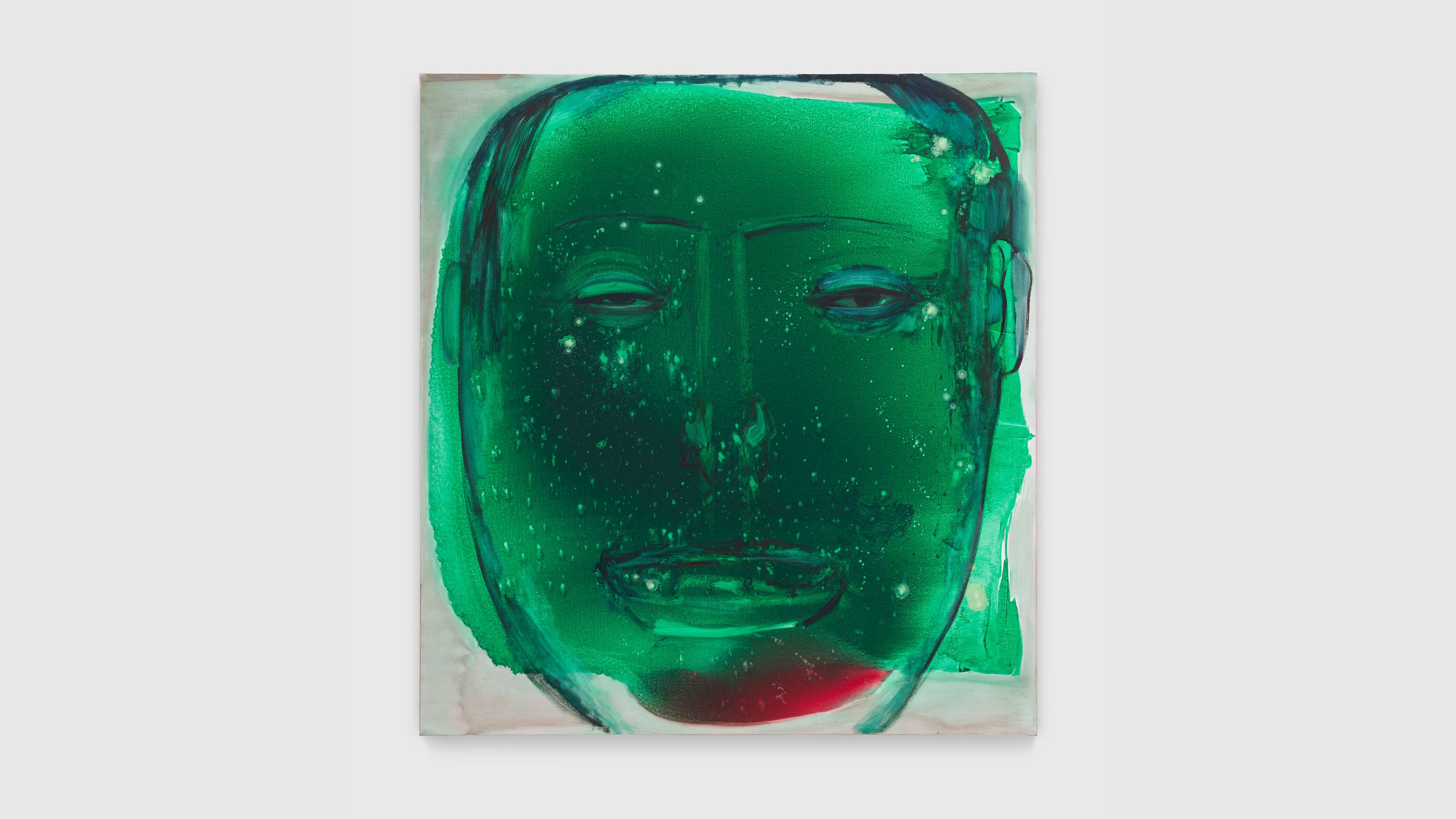
Perucchini’s distinctive body of work draws on a range of influences, from early Italian Renaissance painting and the patterns of African wax print textiles to ancient Greek mythology and frescoes in Ethiopian churches. Populating seemingly familiar narrative scenes with a singular cast of characters often youthful, lithe, and inscrutable in appearance, Perucchini expands the language of figurative painting while deftly mining tropes from religious iconography and traditional portraiture. Many compositions present single or paired subjects in ambiguous situations; other works reference iconic mythical figures, such as Icarus, Narcissus, Inanna, and Gilgamesh, among others. Together, they embody a saturated world that is at once past, present, and imagined.
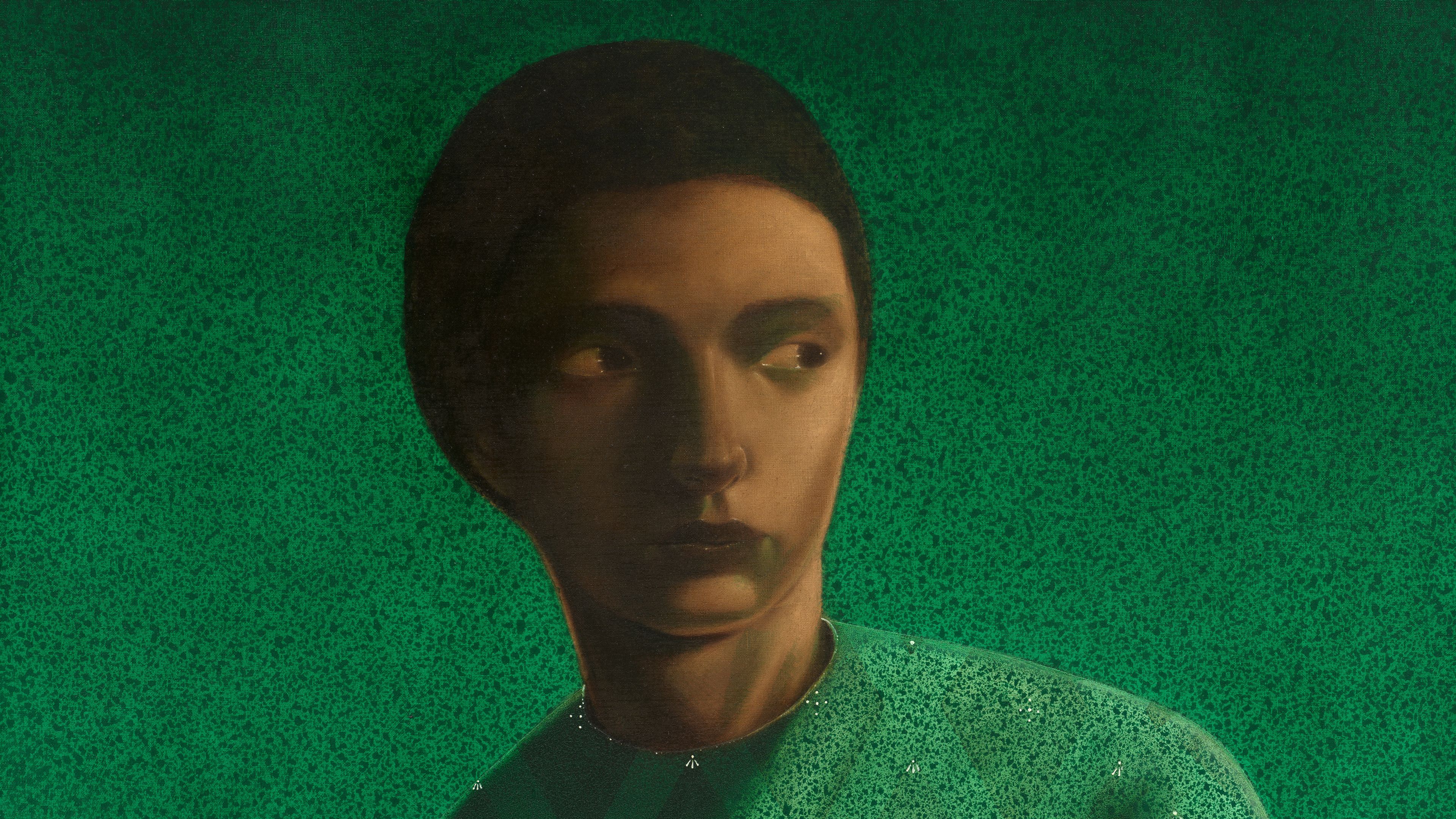
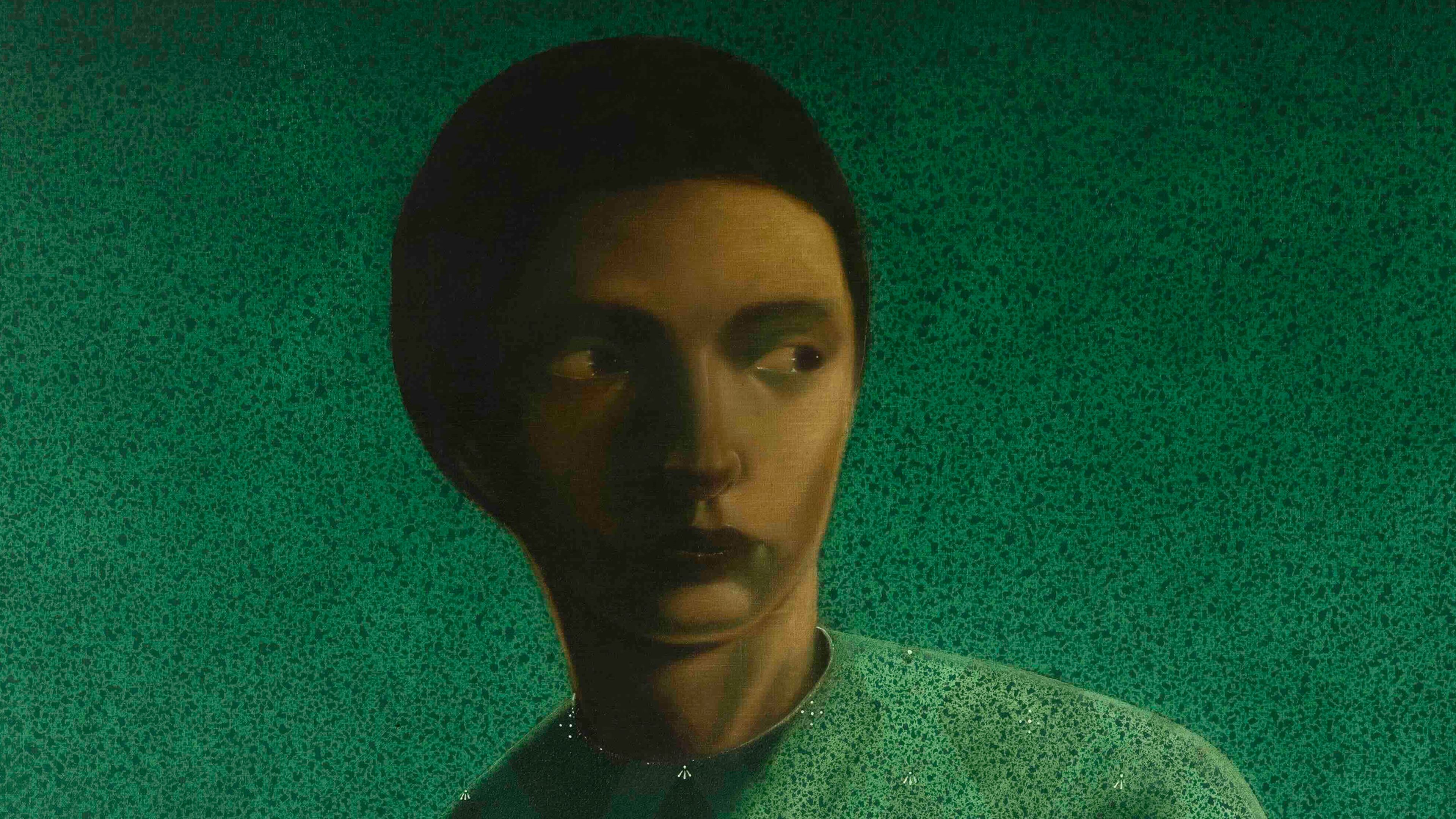
Dominated by monochromatic jewellike hues and frequently illuminated by a glowing spherical moon or sun, Perucchini’s paintings are as much about surface as they are about content. Through a time-intensive process, the artist sprays his canvases with an oil-based emulsion to create a rich, mottled finish, as if the new work has taken on an otherworldly patina. His figures, largely rendered from imagination, are often shown with gazes askance, almost saintlike, as they look far beyond their intricately textured environments toward an unseen world. Existing outside of any familiar historical chronology, Perucchini’s scenes evoke timeless tensions and nuances of the human experience—solitude and partnership, the archetype and the individual, light and darkness.
This show also includes Perucchini’s first public presentation of his drawings; the two compositions on view are his largest works on paper to date. These enigmatic graphite portraits each depict a solitary figure engaged in a game of chess—a recurring motif in the artist’s work wherein the chessboard occupies a space between being and becoming, and each move gives form to what is possible while leaving the unexpected unresolved.
Jem Perucchini (b. 1995) was born in Tekeze, Ethiopia, and raised in Italy. He studied between 2016 and 2021 at the Accademia di Belle Arti di Brera in Milan, where he continues to live and work.
Recent solo exhibitions of Perucchini’s work include The Diaphanous Soul of a Motionless Morning, Centro Andaluz de Arte Contemporáneo, Seville (2025); Evenfall, Fondazione Sandretto Re Rebaudengo, Turin (2025); Strange Fruit, Corvi-Mora, London (2024); Jem Perucchini, Corvi-Mora, London (2022); and Una Boccata d’Arte, Battaglia Terme, Italy (2021).
Perucchini’s work has also been featured in institutional group exhibitions such as Don’t have hope, be hope!, Fondazione Sandretto Re Rebaudengo, Venice (2026); Fantastica. 18ª Quadriennale d’arte, Palazzo Esposizioni Roma, Rome (2025); Pittura Italiana, La Triennale di Milano, Milan (2023); The Skin, Monash University Museum of Art (MUMA), Melbourne (2023); and In Piena Crisi: Frontiers of Italian Art, Italian Embassy, London (2022).
In November 2023, Perucchini completed his first major commission, the public mural Rebirth of a Nation, which was installed in London’s Brixton Underground station as part of Art on the Underground.
Perucchini was the recipient of the Jean-François Prat contemporary art prize in 2023. He is represented by Corvi-Mora, London.
For all press inquiries, contact:
Julia Lukacher jlukacher@davidzwirner.com
Erin Pinover epinover@davidzwirner.com