Los Angeles: 606 N Western Avenue
November 13, 2026—February 6, 2027
David Zwirner is pleased to announce Thomas Ruff: In Series, 1979–2024, the artist’s first major presentation in Los Angeles and his first solo show in the city in over a decade, at the gallery’s 606 N Western Avenue location. One of the most influential photographers working today, Ruff has throughout his career asserted that the photographic method is for him a means to an end: “There’s not one way of making photographs. There are thousands of possibilities you can choose from…. I am just interested in the result and if the result is worth discussing.” This exhibition surveys the artist’s production spanning over four decades, highlighting the multiplicity of procedures he deploys to create his photographs. Providing an overview of Ruff’s most important bodies of work and his in-depth examination of a variety of genres, the photographs on view trace his arc from the analogue to the digital, both underscoring his incorporation of new technologies as they emerge and simultaneous reliance on the old. Works by Ruff will also be shown concurrently at The Broad, Los Angeles, in the group presentation Has the myth been shattered, which will be on view from November 21, 2026, to April 4, 2027.
Ruff rose to international prominence in the late 1980s as a member of the Düsseldorf School, a group of young photographers who had studied under the renowned Bernd and Hilla Becher. Ruff in particular made a radical break with the style of his teachers, establishing a distinct approach to conceptual photography through a variety of strategies, including the use of color, the purposeful manipulation of source imagery, and the enlargement of the photographic print to the scale of monumental painting. Highly influential to subsequent generations of photographers, Ruff’s overarching inquiry into the “grammar of photography” accounts for not only his heterogeneous subject matter, but also the extreme variation of technical means used to produce his discrete series.
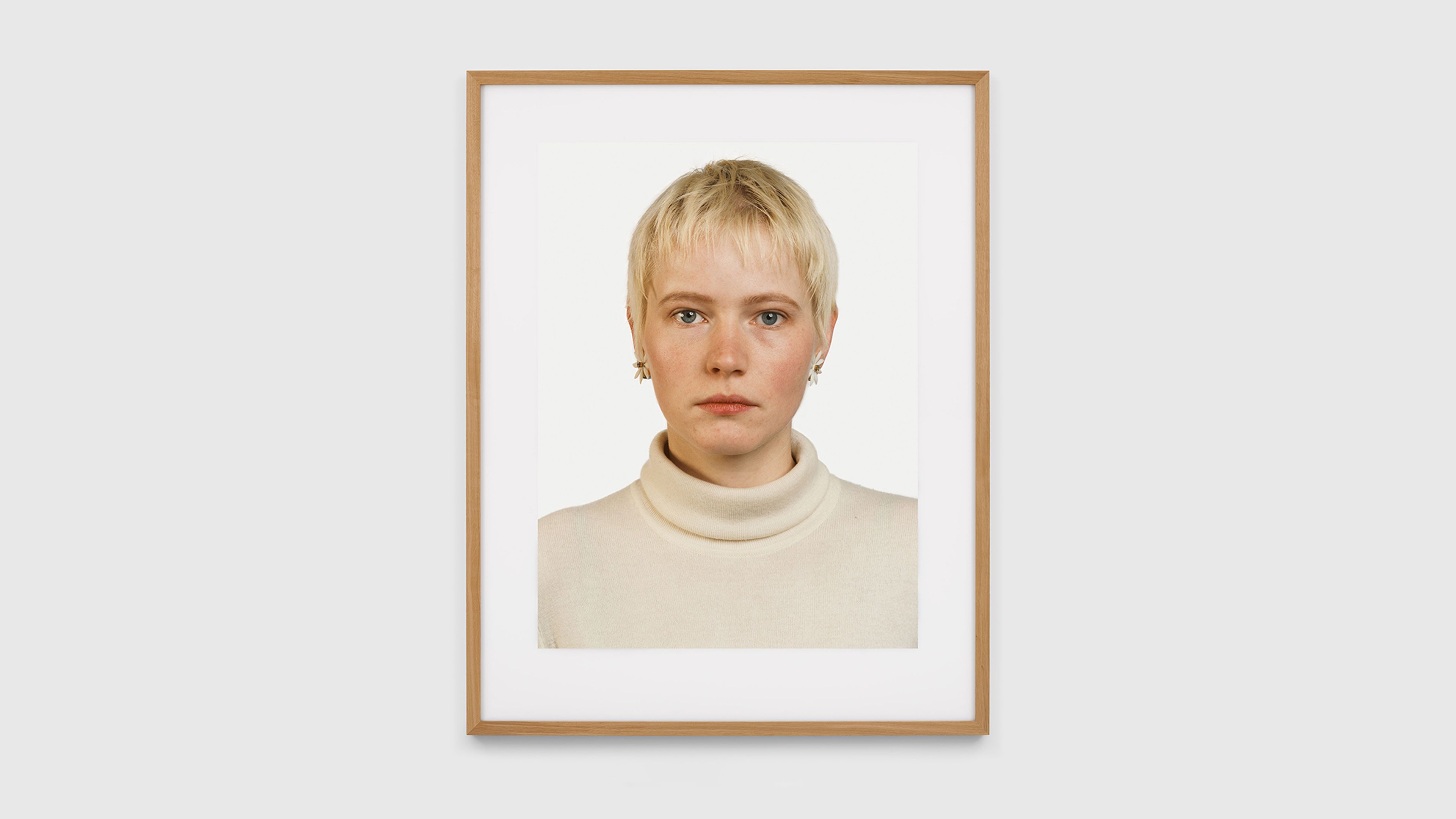
In Series, 1979–2024 opens with a group of Ruff’s breakthrough Porträts (Portraits) from the 1980s, which the artist began while he was still a student at the Kunstakademie Düsseldorf. The large-scale images of his friends, fellow students, and colleagues sought to capture his subjects—always expressionless, set against a neutral background and often looking directly at the viewer—in a neutral, unsentimental manner that defies traditional notions of portraiture. The Porträts are coupled with works from Sterne (Stars, 1989–1992), a body of images that were created from a collection of photographic negatives taken in 1974–1987 at the European Southern Observatory in Chile that Ruff purchased. The titles of these starscapes—twinkling fields of light that verge on abstraction—catalogue the precise position and angle of the telescope, underscoring the artist’s ongoing questioning of the notion of photographic veracity, and—as in the Porträts—the medium’s ability to produce objective documents.
Ruff’s prescient perspectives on the contemporary mass of digital imagery are apparent in nudes (1999–), Substrate (Substratum, 2001–), and jpegs (2004–2022), three key bodies of work that experiment with the manipulation of early digital formats while continuing to engage various themes and techniques in the artist’s repertoire. To create nudes, Ruff downloaded images from online pornographic thumbnail galleries, enlarging and distorting them to varying degrees so that the resulting works are disengaged from their original source. The artist’s images literally and figuratively blur the boundaries between pornography, formalist nude photography, and the art-historical genre of the nude. In Substrate, he accessed online images from Japanese anime and manga, altering them with digital imaging technologies to produce abstract, swirly shapes and to intensify the bold colors of the originals. Ruff amasses the virtual equivalent to a collection of newspaper cuttings in jpegs, creating an archive of digital images based on broad, loosely defined categories, including catastrophes created by humankind or nature, nature conquering human-made creations, and idylls. In addition to indirectly evoking the extreme nature of the subject matter of works in these series, he also indexes the range of digital imagery that is circulated by the media on a constant basis. Appearing painterly and almost abstract, these images together explore the question of the ways in which visual information is circulated and received.
In other series, Ruff presents his own take on architectural photography, the genre for which his mentors the Bechers were best known. The earliest body of work on view is Interieurs (Interiors, 1979–1983), which consists of small-scale, domestic scenes, usually depicting the artist’s own apartment and his family home, a conceptual riff on the Bechers’ “typologies.” Like the Porträts, Ruff presents these interiors in a straightforward but seemingly disinterested manner, with compositions arbitrarily cut off and furniture and walls often shown only partially, appropriating the methods of documentary photography. Häuser (Houses, 1987–1991) further developed these ideas, and was inspired by photographers such as August Sander as well as postwar architectural photography. For Häuser, Ruff drove around Düsseldorf during winter in search of unassuming postwar buildings, which he would photograph from a distance, beneath a bleak or expressionless sky and during early morning hours in order to limit any signs of life. At times, Ruff used then-new digital imaging technologies to touch up the photographs—compromising the seemingly documentary nature of the series in order to stay faithful to his preconceived pictorial vision. Ruff’s photographs are often in dialogue with the history of photography, and feature his own formal experiments in image-making—with or without a camera. The images in expériences lumineuses (2024–) endeavor to devise a method of picturing pure light, the series title harking back to the medium’s origins. Printed on velvety matte surfaces, these works on canvas are actually photographs documenting a physics experiment, engaging with the earliest critiques of the medium that decried photography as a lesser art form than painting. Fotogramme (Photograms, 2012–), a body of work depicting abstract shapes, lines, and spirals in seemingly random formations with varying degrees of transparency and illumination, references the photograms made by surrealist artists in the 1920s; however, Ruff’s works are created entirely in digital darkrooms, allowing the artist more control over their outcome. These are juxtaposed with works from flower.s (2018–), another series that revisits an analogue technique popular with the surrealists, which utilizes digital technologies to achieve the appearance of pseudo-solarization—or the Sabattier effect—that inverts light and dark areas of an image that Ruff has first created. In a similar turn, Ruff inverts existing photographs into negatives in Negative (Negatives), a series he started in 2014.
Surveying the artist’s most acclaimed bodies of work, In Series, 1979–2024 showcases Ruff’s continual and varied modes of experimentation—which have shifted understanding of the discipline of photography beyond the lens—across the spaces of David Zwirner Los Angeles.
Born in Zell am Harmersbach, West Germany, Thomas Ruff (b. 1958) attended the Staatliche Kunstakademie in Düsseldorf from 1977 to 1985.
In 2024, Ruff was the subject of the inaugural exhibition at Malkastenforum, the new building of the Malkasten artists’ association founded in Düsseldorf in 1848. A solo presentation of the artist’s work was on view at K20 – Kunstsammlung Nordrhein-Westfalen, Düsseldorf, in 2020–2021. Works from tableaux chinois, alongside fifteen other series dating back to 1989, were on view in Thomas Ruff: after.images – Works 1989–2020, a major solo exhibition of the artist’s work curated by Martin Germann at the National Taiwan Museum of Fine Arts, Taichung, in 2021. In 2022, Thomas Ruff: Méta-photographie was on view at the Musée d’art moderne et contemporain de Saint-Étienne Métropole (MAMC+), France. Later in 2022, a two-person exhibition, Dark Matter, featuring work by Ruff and James Welling was presented at Kunsthalle Bielefeld, Germany.
In 2018, Ruff was featured in Photography Spotlight, an exhibition at the Victoria and Albert Museum in London that celebrated the opening of the museum’s new Photography Centre. The artist created a new body of work titled Tripe as a special commission to inaugurate the space.
Ruff’s work has been the subject of other solo exhibitions at prominent institutions worldwide, including Whitechapel Gallery, London (2017); The National Museum of Modern Art, Tokyo (2016; traveled to 21st Century Museum of Contemporary Art, Kanazawa, Japan); Art Gallery of Ontario, Toronto (2016); Stedelijk Museum voor Actuele Kunst (S.M.A.K.), Ghent (2014; traveled to Kunsthalle Düsseldorf); Haus der Kunst, Munich (2012); LWL-Landesmuseum für Kunst und Kulturgeschichte, Münster (2011); Centro de Arte Contemporáneo de Málaga, Spain (2011); Castello di Rivoli, Turin (2009); Museum für Neue Kunst, Freiburg, Germany (2009); Kunsthalle Wien, Vienna (2009); Műcsarnok Kunsthalle, Budapest (2008); Moderna Museet, Stockholm (2007); Sprengel Museum Hannover, Germany (2007); Musée d’art moderne et contemporain, Geneva (2004); and Museo Tamayo, Mexico City (2002).
In 2001–2002, Thomas Ruff: Photographs 1979 to Present opened at Staatliche Kunsthalle Baden-Baden, Germany. This major solo exhibition of the artist’s work traveled through 2004 to the Museet for Samtidskunst, Oslo; Museum Folkwang, Essen, Germany; Städtische Galerie im Lenbachhaus, Munich; Irish Museum of Modern Art, Dublin; Artium Museoa: Museo de Arte Contemporáneo del País Vasco, Vitoria Gasteiz, Spain; Museu de Serralves, Porto; Tate Liverpool, England; and Ujazdowski Castle Centre for Contemporary Art, Warsaw.
Ruff’s work has been represented by David Zwirner since 2000, and in that time he has had fourteen solo exhibitions with the gallery, including numerous shows in New York (2000, 2001, 2003, 2005, 2007, 2010, 2013, 2016, 2022, and 2026), as well as exhibitions in London (2016, 2025), Hong Kong (2019), and Paris (2021).
Work by the artist is held in museum collections worldwide, including the Art Institute of Chicago; Dallas Museum of Art; Essl Museum, Klosterneuburg, Austria; Nationalgalerie, Berlin; Hirshhorn Museum and Sculpture Garden, Washington, DC; K20 – Kunstsammlung Nordrhein-Westfalen, Düsseldorf; The Metropolitan Museum of Art, New York; Moderna Museet, Stockholm; National Gallery of Victoria, Melbourne; National Museum of Photography, Copenhagen; Solomon R. Guggenheim Museum, New York; and Stedelijk Museum voor Actuele Kunst (S.M.A.K.), Ghent. Ruff lives and works in Düsseldorf.
For all press inquiries, contact:
Elizabeth Gartner egartner@davidzwirner.com
Julia Lukacher jlukacher@davidzwirner.com