Felix Gonzalez-Torres: Somewhere better than this place / Nowhere better than this place
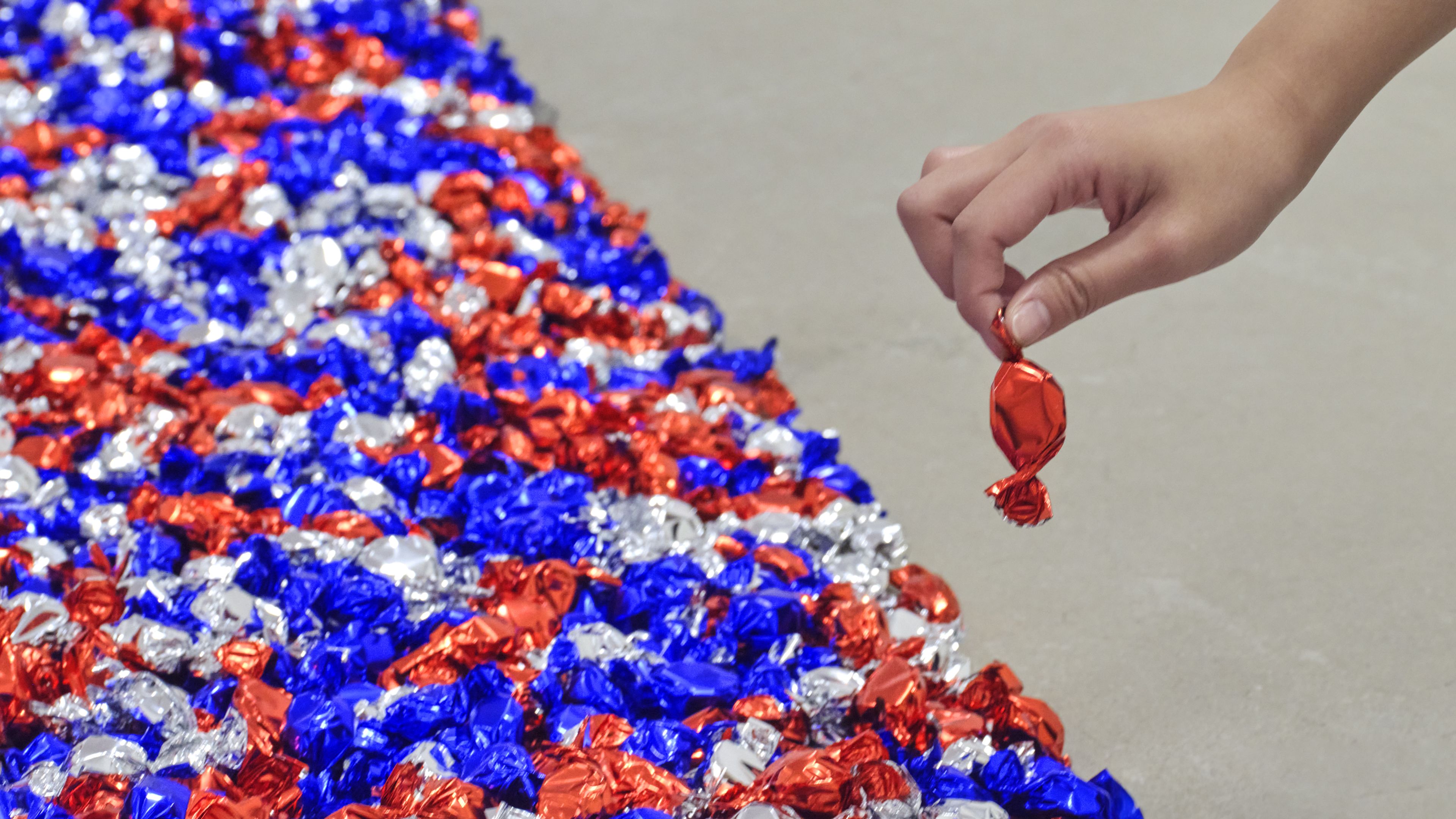
Felix Gonzalez-Torres, "Untitled" (Welcome Back Heroes), 1991 (detail)
Past
November 19, 2025—February 28, 2026
Opening Reception
Wednesday, November 19, 5–7 PM
Opening Reception
Wednesday, November 19, 5–7 PM
Location
Hong Kong
5–6/F, H Queen’s, 80 Queen’s Road Central
Hong Kong
Tue, Wed, Thu, Fri, Sat: 11 AM-7 PM
Artist
David Zwirner is pleased to present Somewhere better than this place / Nowhere better than this place, the first exhibition of Felix Gonzalez-Torres’s (1957–1996) work in Hong Kong. Gonzalez-Torres was one of the most significant artists to emerge in the late 1980s and early 1990s. In its reduced formal vocabulary, conceptual rigor, and evocative use of everyday materials, his work resonates with meaning that is at once specific and mutable, rigorous and generous, poetic and political.
Featuring examples from key bodies of work by the artist, this presentation will also extend beyond the gallery into the city, and will seek to draw out the deep resonances between Gonzalez-Torres’s practice and the city’s complex urban fabric, historical trajectory, and evolving identity. Hong Kong—a place shaped by histories of passage and transformation—mirrors many of the complexities the artist explored throughout his work, which sought to question and collapse dualities such as belonging and estrangement, the particular and the universal, the individual and the collective, and the fixed and the fleeting.
Simultaneous manifestations of candy and stack works in the show will be displayed at significant sites around the city, exploring the complex relationships and negotiations between private and public space, and intimacy and anonymity, that informed Gonzalez-Torres’s practice. By embedding the artist’s work within Hong Kong’s urban environment and daily rhythms, this project brings into question notions of access, who constitutes the public, and what defines public versus private space. The synchronous installations moreover speak to the continued mutability and openness of Gonzalez-Torres’s work: responsive to different contexts, it welcomes the possibility of holding multiple, evolving meanings at once.
Explore

Explore All Works
Upon entering the gallery, the viewer will encounter the artist’s “Untitled” (Fear) (1991), a blue-tinted mirror that at once invites self-confrontation while reflecting and altering the surrounding space in its cerulean cast. Through its evocations of doubling, place and placelessness, presence and specter, the work establishes the open-ended, generative propositions that characterize the artist’s work.
Also on view will be the double paper stack “Untitled” (1989/1990) from which the exhibition takes its title. The work’s quiet, declarative phrases—“Somewhere better than this place.” printed on the sheets of one of the adjacent stacks, and on the other “Nowhere better than this place.”—conjure a grappling with duality, hope, endurance, and the everyday labor of making meaning in the world as it is, while gesturing toward what it could become.
This work will also be manifested within the Central Market Stairwell, an iconic architectural site from the late 1930s and one of the earliest examples of Bauhaus architecture in Asia. The historic Central Market was once the city’s first wet market and now one of the business district’s most popular thoroughfares. In this context, the presence of the double stack “Untitled” becomes a site for negotiating the boundaries of public space itself: who it is for, how it is used, and what kind of meaning can be made or encountered within it. The prescribed flow of people in this space—the stairwell is physically demarcated between ascending and descending sides—dovetails with the double stack itself and the choice the individual makes in taking one of the sheets. The tension espoused by the inscriptions also draws connections to the Bauhaus, whose thinkers and ideological underpinnings embraced the utopian possibilities within the present while looking to the future. This manifestation of “Untitled” in a context where it may not readily appear to be a work of art, and free of overt indication of how and why it has been installed in this site, may elicit drastically different responses from passersby—thus embracing Gonzalez-Torres’s willingness to put his work’s status as art per se into question. Creating structures that endowed unique works with the capacity to exist in more than one place simultaneously, Gonzalez-Torres was unafraid of challenging his work’s ability to endure—despite differences in how it may vary or be perceived from one context to another. When the work was first shown in 1990, he wrote: “I feel this particular installation is about vulnerability, about having nothing to lose, about the possibility of renewal through the recontextualization of each piece every time it’s taken by the viewer. It is also a comment on the passage of time and on the possibility of erasure and disappearance, it is about the poetics of space, presence, and the beauty of chance.”
In another gallery room will be “Untitled” (Couple) (1993), one of Gonzalez-Torres’s unique light string sculptures. As with the candy and paper stack works, Gonzalez-Torres’s use of light strings exemplifies his interest in the poetic potential of commonplace materials. The nature of the artist’s light-string works entails that bulbs be promptly replaced when they burn out—perhaps on one string, perhaps on the other—at once evoking loss and perpetual renewal. Its presence carries particular resonance in Hong Kong, a city characterized by constant rebuilding and flux.
A selection of photographic works and puzzles expands these meditations. Among them is “Untitled,” (1994), composed of a group of four black-and-white framed photographs depicting a trail of clouds with birds soaring in the sky. The motif of birds in flight—as well as clouds—was a recurring one in the artist’s work, and he employed related imagery in varying formats. Such visuals allude to themes of migration, belonging, and the transcendence of fixed boundaries. With the flight of birds, Gonzalez-Torres gives us an understated yet profound symbol of freedom and possibility. Other photographs of footprints in sand, a recurring image found in several of the artist's works that stands as a compelling yet understated index of presence and absence, and of the ephemeral and the perpetual.
A selection of jigsaw puzzle works with a range of photographic imagery will be included, among them works featuring images of crowds, drawing connection to the city’s physical density, and its broader questions of individuality, collectivity, and visibility.
In the final room of the exhibition space will be “Untitled” (Welcome Back Heroes) (1991), which will also be manifested simultaneously in a public setting. As with all of Gonzalez-Torres’s candy works, in which viewers are welcome to choose to take and consume a piece, “Untitled” (Welcome Back Heroes) evokes experiences of what it means to take on the responsibility to engage, while exploring ideas of disappearance and renewal, abundance and loss. While the artist chose Bazooka bubblegum for the original installation of this work, the nature of his candy works allows for different decisions to be made each time the works are installed. Reflecting on the work’s militaristic title as well as the artist’s original choice of candy—with its red, white, and blue wrappers featuring vintage American Cold War-era cartoons—the candies here have red, white, and blue cellophane wrappers, opening the work to multiple, open-ended political and cultural meanings in an interconnected, globalized world. The work will also be on view on a public street corner in the city’s Tai Hang neighborhood. Dense with narrow streets and alleyways, the area is close to the busy commercial district of Causeway Bay and is home to traditional communities, historical sites interwoven with bars, cafes, and shops. This constantly changing enclave is situated precariously between tradition and gentrification, past and future. The work’s presence in these contrasting settings introduces new layers of meaning, further shaped by the shifting dynamics of access and attention, passivity and participation, the movement of bodies amidst the flow of daily life within a city in a state of evolution

Inquire about works by Felix Gonzalez-Torres