Yoshitomo Nara
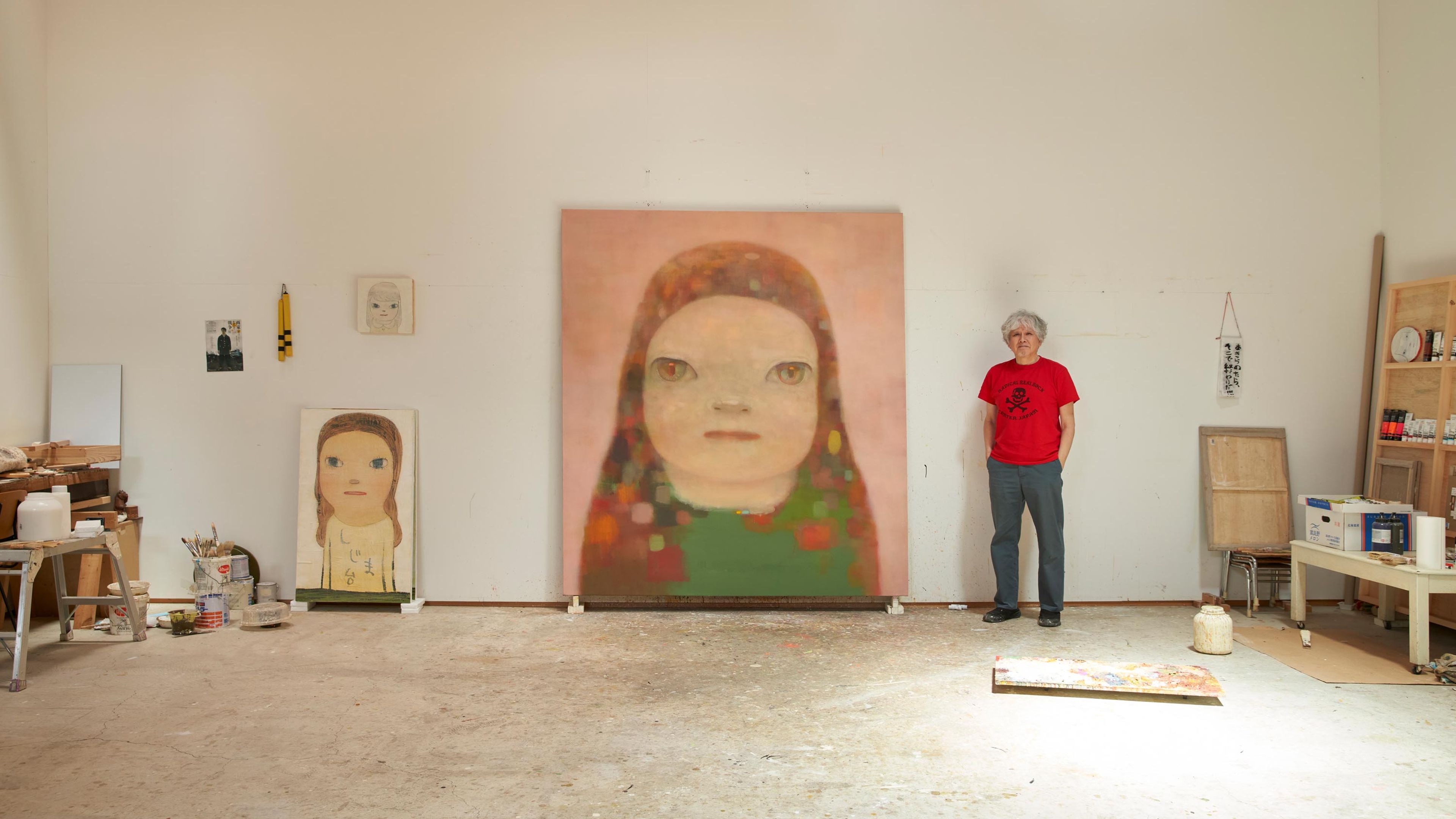
Yoshitomo Nara in his studio, 2026. Photograph: Keita Saiki, Artwork: Yoshitomo Nara
Coming Soon
November 5—December 12, 2026
Opening Reception
Thursday, November 5, 6–8 PM
Opening Reception
Thursday, November 5, 6–8 PM
Locations
New York: 19th Street
533 West 19th Street
New York, New York 10011
New York: 20th Street
537 West 20th Street
New York, New York 10011
Thu: 6 PM-8 PM
Fri, Sat: 10 AM-6 PM
Artist
David Zwirner is pleased to present an exhibition by Japanese artist Yoshitomo Nara, featuring new paintings and drawings, recent sculptures, and earlier works selected by the artist. Spanning the gallery’s 537 West 20th Street and 533 West 19th Street locations in New York, this exhibition will be the artist’s first solo presentation with David Zwirner and his first major solo exhibition in New York in nearly a decade.
Explore
Thank you for subscribing.
The nearly one hundred works on view explore Nara’s multidisciplinary approach and his multifaceted worldview. Behind his artistic creativity and his exceptional technical mastery of materials and methods lies an expansive imagination and a deeply personal sensibility originating from his solitary childhood growing up in Aomori in rural northern Japan, at a time when the nation’s rapid economic growth had yet to reach the region—being physically remote and culturally separate from the big cities, it had its own unhurried pace. Memories of snow-covered landscapes and a connection with nature and all living things remain present for Nara.
Another crucial catalyst for Nara’s artistic expression was his revelatory discovery of music. From an early age, he became drawn to the sounds he discovered across the airwaves, on radio broadcasts from the US military’s Far East Network that included folk songs, country, and soul music. Nara had no understanding of the lyrics, but he was in thrall to the rhythms and melodies, the sincerity and longing carried on the music’s often-melancholic tones. Nara absorbed these emotions on a sensory level, allowing them to resonate deeply within his mind and body.
Nara creates art in order to express and communicate what he feels unable to convey in words, and his distinctive body of work has evolved through his ongoing search to identify what is uniquely his: his upbringing in rural northern Japan at a particular moment in time and, above all, his profound concern for humanity, including those outside mainstream society.
In his new work, Nara has furthered his exploration of the possibilities of color expression and accomplishes a sense of humidity and luminosity with his muted, low-saturation palette. His figures on canvas emerge from richly atmospheric layers of soft, earthy colors. Through a process of repeatedly applying paint and reworking it, Nara searches for what is essential. His paintings on styrene boards and wood panels place a renewed emphasis on materiality. He often repurposes materials from his studio to construct supports, appreciating the familiarity of used objects that are present in his everyday life. Collaging pieces of cut fabric, printed papers, and corrugated cardboard from packing boxes, he creates surfaces that become integral to the work, their creases and ridges enriching the physical presence of the image.
To inform his latest works, Nara has selected a group of earlier drawings and paintings to be exhibited alongside them. Two drawings from 1988 show his initial attempts to express his inner self. In the early 1990s, following his move to Germany, Nara began to explore and develop his own pictorial language, and at the same time, under the advice of A. R. Penck, his professor at the Kunstakademie Düsseldorf, Nara integrated his drawing style into his painting practice. This was a pivotal transition. Nara simplified his compositions and began to apply paint with the same freedom that he used pen and pencil, leading to the development of his own characteristic style and the consolidation of his now established motifs.
Whichever medium or implement Nara chooses, drawing is an assured action, the result of an immediate inspiration. In his new group of large-format monochrome drawings—made this year using industrial oil-based paint sticks—broad, richly opaque lines concentrate his imagery and narrative elements, strengthening their symbolism, and emphasize his fluid delineation. Nara gives direct expression to his imaginative world in these bold drawings, inspired without hesitation by the music he is listening to—a melody or lyric.
In conjunction with the presentation of paintings and drawings at 20th Street, thirteen sculptures from 2024 will be on display at the 19th Street gallery. These monumental bronze heads, coated in white urethane paint, recall the snow-covered forests on Mount Hakkōda, near Nara’s hometown in Japan. Drawing on the beliefs of ancient folk religions, Nara understands the natural world that lies beneath the snow to possess a spiritual essence or a living soul, its elements communicating with each other—tree to mountain, water to stone. Standing like ancient monoliths, light and shadow playing across their smooth surfaces, Nara’s sculptures nurture conditions for serenity and contemplation.
This exhibition coincides with Yoshitomo Nara: Sentinels of Stillness at the Hirshhorn Sculpture Garden in Washington, DC. Three monumental sculptures will be on display through November 7, 2027, inaugurating the Annual West Lawn Series. A major retrospective of Yoshitomo Nara’s work is also due to open in fall 2027 at the San Francisco Museum of Modern Art.